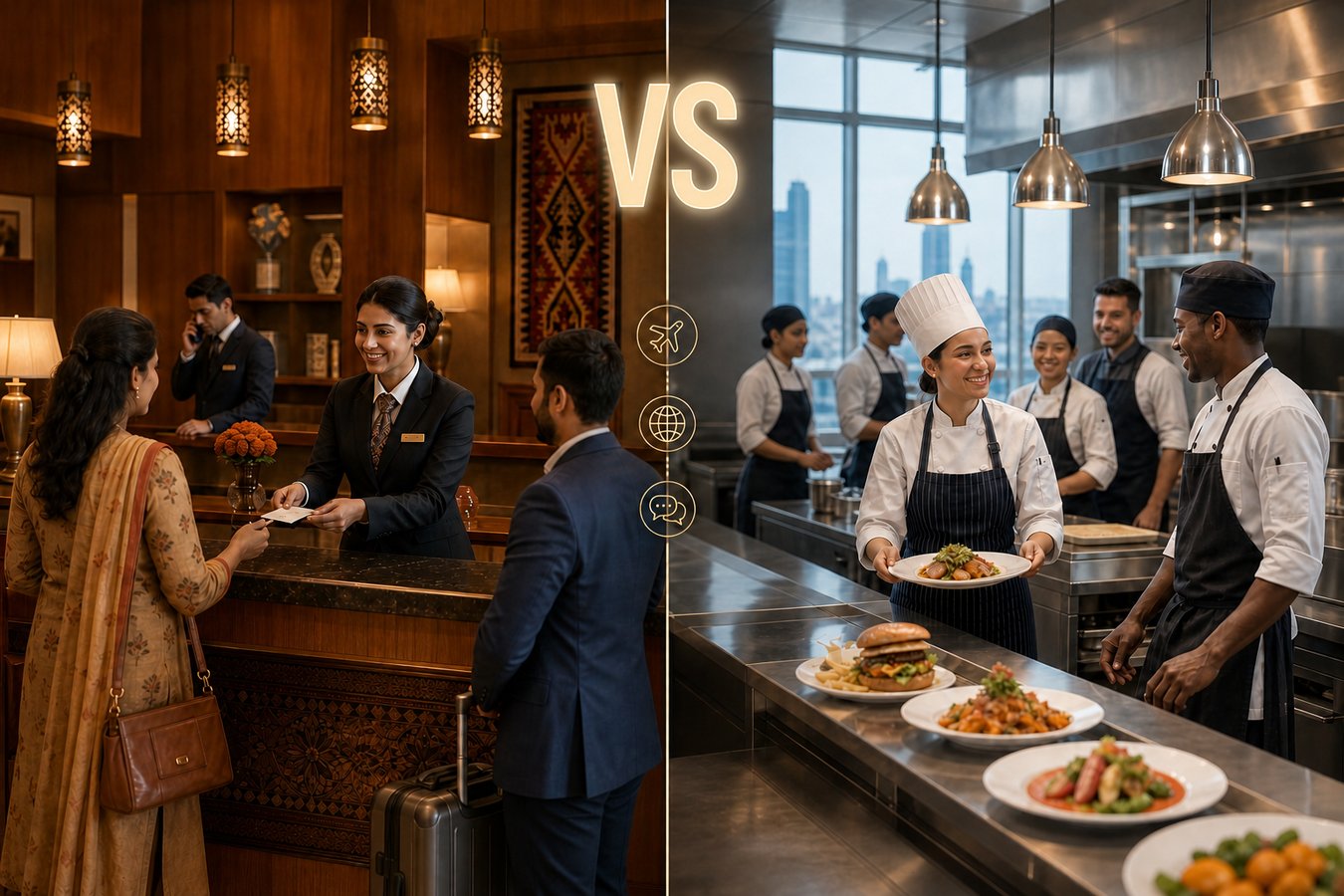
Your first hospitality experience can shape your future. But does it need to take you across the world?
Imagine two hospitality students beginning their professional journeys.
One joins a well-established hotel in their home country, learning how daily operations work while building relationships within the local hospitality industry.
The other travels to the United States through a J-1 Exchange Visitor Program, experiencing American hospitality practices while adjusting to a new culture, language, and environment.
Both are gaining valuable experience.
But their learning journeys may look very different.
If you are considering a career in hospitality, culinary arts, food and beverage, or rooms division, choosing between a J-1 Visa Program and a local internship is not simply about deciding where to train.
It is about understanding what you want to learn, which experiences matter to you, and how each option fits your long-term goals.
Let's explore the differences.
Understanding the Two Paths
What Is a Local Internship?

A local internship is a practical learning experience completed within your home country or existing place of residence.
Hospitality students and graduates may participate in internships at hotels, restaurants, resorts, or other hospitality establishments to develop practical skills and understand professional operations.
Depending on the organization, internships may involve supervised learning, departmental assignments, and exposure to guest service standards.
One advantage is familiarity.
You may already understand the language, cultural expectations, transportation system, and general cost of living.
This can make it easier to focus on developing your technical abilities while building professional connections close to home.
What Is the J-1 Visa Program?
The J-1 Exchange Visitor Program is a U.S. cultural exchange initiative administered by the U.S. Department of State.
Among its various categories are the Intern and Trainee programs, which provide eligible international participants with structured, supervised practical training opportunities in approved occupational fields, including hospitality and tourism.
Unlike ordinary employment, J-1 Intern and Trainee placements must have an educational and cultural exchange purpose.
Participants follow an approved training plan, typically documented through Form DS-7002, outlining their learning objectives, supervision, and training activities.
The experience is designed to support professional development while encouraging mutual cultural understanding between participants and their American host communities.
J-1 Visa Program vs. Local Internship: Key Differences
|
Category |
Local Internship |
J-1 Intern / Trainee Program |
|
Location |
Usually within your home country |
United States |
|
Primary experience |
Practical training in a familiar environment |
Structured training combined with cultural exchange |
|
Cultural exposure |
Depends on the workplace and guest profile |
Direct exposure to U.S. culture and international communities |
|
Language |
Often your native or local working language |
English communication in an American environment |
|
Training structure |
Varies by employer or institution |
Documented training objectives and supervision |
|
Eligibility |
Depends on local requirements |
Specific U.S. program eligibility requirements |
|
Costs |
Often lower relocation and travel expenses |
May involve visa, program, insurance, travel, and living expenses |
|
Professional network |
Primarily local, potentially international |
Opportunities to develop connections across cultures |
Neither option guarantees employment, career advancement, or a particular salary.
The value of each experience depends on the quality of the training, your involvement, and how you apply what you learn.
1. Professional Development: Familiarity vs. New Perspectives
A local internship can provide a strong foundation in hospitality operations.
You may develop confidence in guest communication, learn standard operating procedures, and understand how hospitality businesses operate within your country's market.
This foundation can be especially valuable for students beginning their practical training.
A J-1 program introduces an additional learning dimension: adapting to professional practices in another country.
For example, a culinary participant may encounter unfamiliar ingredients, kitchen procedures, and food preparation methods.
A food and beverage participant may learn how American establishments approach guest interactions, teamwork, and service delivery.
A rooms division participant may experience different operational systems and guest expectations.
These experiences can encourage adaptability and broaden professional perspectives.
The key difference: A local internship can help you build skills within a familiar environment, while an international training experience may challenge you to apply and expand those skills in an unfamiliar one.
2. Cultural Exchange: Learning Beyond Hospitality
This is one of the most distinctive aspects of the J-1 Exchange Visitor Program.
While local internships may provide opportunities to interact with international guests and colleagues, the J-1 program places cultural exchange at the center of the experience.
Participants may discover new traditions, experience local celebrations, explore American destinations, and build friendships with people from different backgrounds.
Everyday experiences can become opportunities for cultural learning.
Ordering food, navigating transportation, participating in community activities, or celebrating holidays with colleagues may reveal differences in communication and social expectations.
These moments can help participants become more culturally aware, independent, and adaptable.
Cultural exchange is also a two-way experience.
Participants have opportunities to introduce their own traditions, perspectives, and cultural backgrounds to their host communities.
For individuals who want to combine hospitality training with international cultural discovery, this can be a meaningful advantage.
3. Language and Communication Skills
Communication is essential in hospitality.
Whether you work in culinary operations, guest services, or food and beverage, understanding instructions and interacting effectively with colleagues can influence the quality of your training experience.
A local internship allows you to develop professional communication skills in an environment where you may already feel comfortable.
A J-1 experience in the United States may offer more frequent opportunities to communicate in English.
You may become more familiar with different accents, professional expressions, and communication styles.
However, language development is not automatic.
It requires active participation, asking questions, listening carefully, and making an effort to communicate beyond your comfort zone.
Importantly, J-1 applicants must already demonstrate sufficient English proficiency to participate successfully in their programs.
The experience is an opportunity to strengthen communication skills, not a substitute for meeting initial language requirements.
4. Costs and Financial Planning
Financial preparation is another important consideration.
A local internship may involve fewer relocation expenses, particularly if you can continue living at home.
However, transportation, accommodation, meals, and other expenses can still affect your budget.
A J-1 program generally requires more extensive financial planning.
Depending on your circumstances and program arrangements, potential expenses may include:
- Program and administrative fees
- Visa application and applicable government fees
- International airfare
- Health insurance
- Housing and transportation
- Initial living expenses
Some J-1 training opportunities offer compensation or financial support, but arrangements vary.
Applicants should review their training terms, estimated expenses, and financial responsibilities before committing to a program.
Important: A J-1 visa is a temporary exchange visitor classification. It should not be viewed as a guarantee of long-term employment or immigration opportunities in the United States.
5. Eligibility: Which Program Can You Join?
Local internship eligibility depends on the requirements established by the institution, employer, and applicable local regulations.
For J-1 hospitality training, the U.S. Department of State establishes specific requirements.
J-1 Intern Program
The Intern category generally applies to foreign nationals who:
- Are currently enrolled in and pursuing studies at a degree- or certificate-granting post-secondary institution outside the United States; or
- Graduated from such an institution no more than 12 months before the start of their exchange visitor program.
J-1 Trainee Program
The Trainee category generally applies to foreign nationals who:
- Hold a degree or professional certificate from a foreign post-secondary institution and have at least one year of related professional experience outside the United States; or
- Have at least five years of relevant professional experience outside the United States.
Additional eligibility requirements and program limitations apply.
For hospitality and tourism, the maximum training duration is generally 12 months, including under the Trainee category.
Applicants should confirm their eligibility and the applicable program conditions before applying.
6. Which Experience Is Better for Your Hospitality Career?
There is no single answer that applies to everyone.
The right choice depends on your current experience, financial situation, learning objectives, and long-term ambitions.
A Local Internship May Be Better If You:
- Are beginning your hospitality education and want foundational experience.
- Prefer to build confidence in a familiar environment.
- Want to minimize international travel and relocation expenses.
- Are exploring which hospitality department interests you most.
- Want to develop professional connections within your local industry.
A J-1 Program May Be Better If You:
- Meet the relevant J-1 eligibility requirements.
- Want structured international hospitality training.
- Are interested in experiencing American culture firsthand.
- Feel prepared to adapt to a different language and environment.
- Want to broaden your cultural awareness and professional perspective.
- Have planned for the financial and personal responsibilities of living abroad.
Neither choice is inherently more prestigious or valuable.
A meaningful experience comes from clear learning objectives, appropriate supervision, and your willingness to grow.
7. Do You Have to Choose Only One?
Not necessarily.
For many aspiring hospitality professionals, a local internship and an international exchange experience can complement each other.
A local internship may help you build practical skills, understand professional expectations, and identify your interests.
Later, if you meet the eligibility requirements, an international J-1 program may offer an opportunity to apply your knowledge in a different environment.
Alternatively, eligible students may explore international training earlier in their professional development.
What matters is choosing an experience that supports your current stage of learning.
Hospitality careers develop through continuous education, practical experience, and exposure to different people and perspectives.
Your journey does not need to follow exactly the same path as someone else's.
Questions to Ask Before Making Your Decision
Before choosing a training program, consider these questions:
- What specific skills do I want to develop?
- Am I ready to live and learn in a different cultural environment?
- Do I meet the eligibility requirements?
- Can I responsibly manage the expected expenses?
- What kind of training structure and supervision will I receive?
- How will this experience support my long-term hospitality goals?
Taking time to answer these questions can help you make a more informed decision.
Final Thoughts: The Best Experience Is the One That Helps You Grow
Your hospitality journey is not defined solely by the country where you complete your training.
It is shaped by the people you meet, the challenges you overcome, and the knowledge you gain along the way.
A local internship can provide a valuable introduction to professional hospitality.
A J-1 program can offer a distinctive combination of structured training and cultural exchange in the United States.
Both can contribute to your development when approached with curiosity, commitment, and realistic expectations.
Ultimately, the better option is the one that aligns with your goals and prepares you for your next stage of growth.
Explore International Hospitality Training with HRC International
Interested in discovering what a J-1 cultural exchange experience could offer?
HRC International connects eligible hospitality students, recent graduates, and professionals with international training opportunities in the United States.
Whether your interests lie in Culinary Arts, Food & Beverage, or Rooms Division, exploring your options is the first step toward making an informed decision.
Explore Available Opportunities and Apply Now
References
- U.S. Department of State — BridgeUSA: Intern Program
- U.S. Department of State — BridgeUSA: Trainee Program
- U.S. Department of State — Exchange Visitor Program
- U.S. Department of State — Adjusting to a New Culture
- U.S. Department of State — Exchange Visitor Visa Information